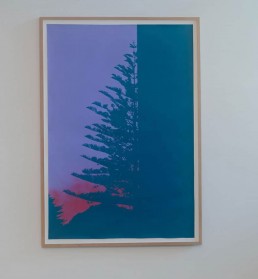
A Natureza segundo Jorge Santos, na Abreu Advogados
Por José Pardal Pina
A planta que nasce por entre as fendas do betão é um triunfo do cosmos. Com o tempo, o inerte cede ao desgaste do que por ele passa; o vento traz a poeira necessária para a germinação; o acaso, trazido por uma ave, chutado pelo pé, empurrado pela água, deposita a semente que brota sobre o cinzento artificial.
A vita activa tolda-nos o olhar contemplativo e sonega todo e qualquer devaneio possível. A imaginação tem um propósito capital e nunca prazeirento. O bulício da produção e da atividade, dos fluxos e dos horários, deprime e esgota. Não há lugar para a indolência, para o vagar. Escapa-se-nos a planta que nasce por entre as fendas do betão, a árvore que espreita por entre os edifícios, a flor nos buracos da calçada. Indiferentes a corpos estranhos e a existências diferentes das nossas, escapa-se-nos a comovente indiferença da natureza a tudo o que o homem produz. O drama da ecologia é o homem esquecer que faz parte da natureza.
Em Walden ou A Vida nos Bosques, Henry David Thoreau escreve a sua experiência ascética e simbiótica com a natureza. Thoreau estabelece inicialmente a economia mais doméstica do quotidiano no bosque e nas margens do Lago Walden, para dissertar depois sobre o trabalho e a vida no campo. Mas é a sua visão crítica sobre os tempos da natureza e do homem que estimulam o leitor. Walden faz o que Byung-Chul Han poderia chamar de pedagogia da visão. Sob o olhar atento e vivo de Thoreau, lembramos o prazer da natureza e nela a verdadeira possibilidade de liberdade.
A obra de Jorge Santos tem trabalhado esta tensão entre natureza e cultura, entre o orgânico e o inorgânico, entre campo e cidade. Está na mesma linha de pensamento romântico de Thoreau, mas os caprichos da modernidade situam-no também na visão contemporânea do universo e do que de melhor pode ser resgatado do passado para ser novamente refletido no presente e no futuro.
A linguagem plástica da pintura é também a da atualidade: as formas são as estritamente necessárias e a sugestão tem mais poder que a concretude – adensando alguma da sensualidade das formas e dos temas representados. Nessa sugestão cabe o fascínio pelo botânico e pelos lugares; cabe a surpresa no virar da esquina e o estudo minucioso dos cortes e recortes, do cheio e do vazio; cabem o tempo e o espaço espalmados no papel e, portanto, a duração de um momento, seja ele fugidio ou vagaroso. O desenho vinga sob a profusão que podia ser a pintura. A cor é o elemento diferenciador da materialidade e a gradação de tons num mesmo plano é um trabalho recente. A obra vive, então, desta ambiguidade de campos plásticos, de não saber se é mais desenho ou se é mais pintura. Mas é aí que reside justamente o interesse da sua obra.
A exposição que Santos agora apresenta no novo espaço da Abreu Advogados é um compêndio das linguagens, gramáticas e léxicos que o artista tem vindo a explorar ao longo dos tempos. Em Flower Ornament relembra-se a aproximação às artes decorativas e ao diálogo com a Fundação Ricardo Espírito Santo; em Sun Around the House recorda-se a sala improvisada no espaço galerístico A Montanha. Estes são, todavia, detalhes de um portefólio bem mais vasto, que extravasa a planaridade do papel ou a quietude das formas. A série Trepadeira é uma composição tridimensional de várias pinturas, e em Bucólico há uma curiosa experiência em vídeo, que, não obstante a expressão da imagem em movimento, está mais próximo da pintura (e, depois, do desenho) que qualquer outro projeto fílmico.
Ressalta, contudo, a beleza das atmosferas: o calor sobre os canaviais, as janelas que se abrem para a vegetação densa, o mistério das plantas, das árvores, da natureza; o prazer ocioso que deixa ver o sol e o tempo passarem; a indulgência da ordem natural que perdoa e borra a incúria humana. Deste modo, as obras de Jorge Santos são, para o espectador, um guia do olhar, um convite à meditação, que inspira, como toda a arte, a viragem da vita activa para a vita contemplativa. No fundo, a sua obra é o que Nietzsche referiu em Crepúsculo dos Deuses e que o já mencionado Byung-Chul Han reciclou: “acostumar o olho à serenidade, à paciência, ao paulatino aproximar das coisas”.
Subordinada ao tema da Natureza, e já na terceira mostra de 2019, a exposição de Jorge Santos, com a curadoria de Lourenço Egreja, é uma colaboração entre o Carpe Diem Arte e Pesquisa e a Abreu Advogados e pode ser visitada até 28 de fevereiro.
In Umbigo Magazine, http://umbigomagazine.com/pt/blog/2020/01/17/a-natureza-segundo-jorge-santos-na-abreu-advogados/


Umbigo - Vitrine

Vitrine, by Jorge Santos
by José Pardal Pina
Sit down and watch the time go by in the living room, in the bedroom, in the office, in the studio – an attentive stone by the side of a window.
Wait for the twilight and the low, golden, orange light.
Watch the sunrays drawn on the wall, the projected shadows of the accumulated objects; see the dust flakes slowly come down and shine under the light.
The glowing dots of the shutter, beyond the veil of the undulating curtain, move along the late afternoon’s melancholy and a sun that has all the time in the universe.
The shadows of the dancing grove give life and disturb the superficial stillness.
Wait until the weight of the stoned existence is troubled by the yelling, the sounds and the movement outside.
Sit down and watch the time pass by, yet again, amid the sedation of postponed obligations, to contemplate a worthless existence.
Art is often a phenomenological study of the worldly things – an immersive, radical experience of the phenomena that constitute time, space and life. An annotation of a moment, the dilation – poetic, if we want to – of a fraction of time, minuscule, microscopic, speciously touching and beautiful. When beauty still mattered…
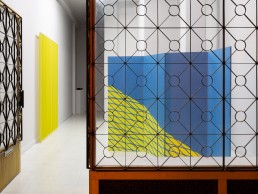
With the exhibition Vitrine, Jorge Santos takes this phenomenological analysis of the inhabited space into art. This vitrine displays and complexifies the interior/exterior relationship, whilst providing its nature as a dividing element. We have always chosen what to show in this vitrine: a crucial play-acting for social survival.
The major elements are present, as if somehow removed from Gaston Bachelard’s The Poetics of Space. The light and shadow drawings, the subtraction of forms, the brise-soleil curtains, the folding screen, the hypothesis of an interior animation; and then, of course, the absolute signage between the exterior and the interior, the public and the private.
The formal two-dimensionality of the works has a stripped-down approach. We can perceive this exhibition as a great installation-environment that easily composes and decomposes into the several dimensions of dwelling-in-space from a mental standpoint. But it is the painting, consubstantiated in pure exercises colour-drenched exercises, that deserves the spotlight. We live (in) a painting, (in) a flat picture, immortalized, of the house, the home.
The technique is often found in this artist, but has a different dimension here, focusing on the basic elements of life. Before, the benchmark cut-outs moved in and out – from the erratic bystander, who stares at the windows and tries to guess the experience taking place inside – or between the ribbed and traced element formed by plant motifs, now Santos only minds the inner side. A reclusive insight that reaps the most basic: light and colour.
Contemplating the exhibition from a formal point of view is something curious, borderline formalist, or, alternatively, from the gestaltic perspective, and through the psychology and perception of shapes and colours. Of what constitutes first and second planes, of the three-dimensional flatness and completeness of forms, which is suggested in a stylized way: of the unseen window, as it is not depicted, but whose presence can be perceived due to the cut-outs and light planes; of the projected shadow and the shadow of the railing itself, doubly displayed; of the distances, of the spaces nearby, of the measures of things considering the representations.
The familiarity of the composition and the themes imply a perceptive subjectivity on the viewers’ side. The conclusion is a manifesto of this familiarity and intensity, with which each individual lives the space they inhabit.
To see until October 7, in the gallery A Montanha.
IN: http://umbigomagazine.com/pt/blog/2018/10/03/vitrine-de-jorge-santos-2/

A compliment to the decorative arts

Um elogio às artes decorativas
por José Rui PP
A exposição Flower Ornament, de Jorge Santos, constitui um raro elogio a um género artístico que já conheceu dias e reputação melhores: as artes decorativas, que, no passado, enchiam oficinas e posteriormente palácios e casas senhoriais. As madeiras eram talhadas, a folha de ouro aplicada, as pratas gravadas, os panos de armar cosidos durante dias a fio, à bruxuleante luz de velas. Seriam estes saberes, este conhecimento do labor preciso e minucioso, esquecidos pela industrialização acelerada dos últimos séculos, não fossem escolas como a Fundação Ricardo do Espírito Santo Silva (FRESS), numa existência híbrida entre museu e escola, a manter muitas das técnicas ancestrais legadas pelos mestres da antiguidade.
Jorge Santos recorda este léxico escamoteado pelo tempo e mostra uma série de obras que colocam em diálogo a arte contemporânea com as artes antigas que integram a FRESS. O resultado é semelhante a um relevo suave, contemporâneo de outras obras presentes no vasto espólio da fundação.
De facto, esta exposição não poderia ter lugar de repouso mais acertado que este museu. O verdadeiro significado de contemporâneo afigura-se aqui com indubitável clareza: contemporâneo não é o presente, não é o “agora”; a arte contemporânea não é a arte do presente, é antes a arte que estabelece uma dialética entre tempos distintos e os aproxima, que revela ao olhar uma coexistência temporal entre motivos aparentemente distantes de várias épocas. Jorge Santos devolve-nos, portanto, aquele tempo olvidado em que o ornamento era belo e desejado nas pequenas coisas úteis, num confronto direto entre o tempo das obras da coleção da fundação e a atualidade.
O dourado metalizado com que estas impressões cegas foram pintadas, repousa sobre o azul da parede e ofusca o olhar e dá o requinte presente, por exemplo, na Sala Nobre. Um pouco por todo o palácio encontra-se esta conjugação de tons que Yves Klein tão bem trabalhou.
A arte de bem adornar requer uma sensibilidade rara a que nem todos conseguem aceder. O que está impresso são arranjos florais. Nada há como uma jarra de flores sobre uma cómoda, na mesinha de centro, ao lado do quadro, para dar vida ao lar; um certo gosto burguês vem à memória e a associação não será inocente. Joana Consiglieri, autora do texto expositivo, nota que “as flores emergem de uma intimidade oculta”. E a repetição seriada deste motivo torna a ação num “ritual sagrado”. O espetador tem o privilégio de aceder à ritualização (expandida pela cor dourada) da relíquia da natureza que é a flor e que a arte e a poesia têm vindo a eternizar.
Mas se os motivos florais são reconhecíveis, também a ausência é notória. Só o contorno se mostra para criar um vazio. Este vazio, por seu lado, é manifesto de uma beleza caduca, a anunciação lenta de uma morte. As flores expiram com o tempo a sua beleza. Arrancar uma flor à natureza é transportar um pedaço do seu assombro para um lugar privado. E isso acarreta uma perda. Deste modo, a exposição Flower Ornament não deixa de narrar também uma certa perenidade de instantes belos, mas fugazes e que Jorge Santos cristaliza nas suas obras.
—
Flower Ornament, de Jorge Santos, na Fundação Ricardo do Espírito Santo Silva, até 30 de junho.
IN: http://umbigomagazine.com/um/2017-05-30/flower-ornament-de-jorge-santos.html
Vitrine
Vitrine
A Montanha presents Vitrine, an exhibition by Jorge Santos with five elements – a curtain, a
folding screen, a painting and a video -, which, all together form an installation.
As in previous works, Santos is attracted by and selects a thematic form, which he then
explores, developing variations around it. This time the form is the grid of a shop window,
which serves as protection and security, but also allows one to see the inside of the space
it protects, but in a conditioned way, hiding parts. However, Santos’s interest is not only in
the form itself, but also in the shapes created by the light – natural and artificial – shining
through the grid, into this ‘protected’ space.
The artist invites us to enter the space from which we were initially excluded, in an act of
seduction, creating a relationship that is pictorial and two-dimensional, in which we are
observers, or more physical and sculptural, in which we can be involved.
Therefore, the window acts as intersection and interstice, it separates and joins, between
the inside and the outside. This encounter generates a third space, third because it is not
only an interior, but an interior conditioned by external light, and by the forms affecting it.

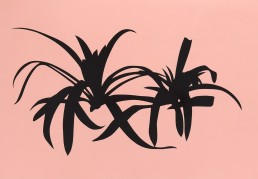
The Language of Plants
The exhibition 'A Linguagem das Plantas' opens on January 30 (6:00 p.m. to 9:00 p.m.).until March 6, at the Giefarte Gallery.
In A Linguagem das Plantas, the artist Jorge Santos presents several series of paintings, as if they were "standard modules", provoking minimal and repetitive chromatic games. In space, works multiply in rhythm and pure color, in an analogy to the simplicity of oriental painting patterns. In this project, the artist perceives the language as a form and color, presenting in delicate lines the plants, whose compositions are determined by a "painting with scissors", in a dichotomy between flat and uniform colors, staging the movement and the lightness that flows . This privileged vision of the Plant puts the viewer in other conceptual aesthetic experiences, namely, the Belo and the poetic language of the work of art
USEFUL INFORMATION
DATES | January 30th through March 6th
HOURS | Monday to Friday, 11am to 2pm and 3pm to 8pm
MORADA | Giefarte - Rua da Arrábida, 54 B-C, Lisbon
CONTACT US | (+351) 213 857 731 or giefarte@mail.telepac.pt
WEBSITE | www.giefarte.pt
ENTRY | Free
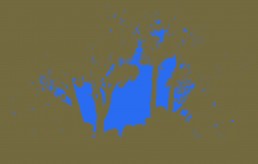
Flat Image

Flat Image responds to the need for reduction in scale during increasingly unaffordable times. The works selected reflect on larger reality by making it into a two-dimensional image, bringing vast spaces into the confines of a small gallery perimeter. Artists Olivia Bax, Nicky Coutts, Theodore Ereira-Guyer, Sam Llewellyn-Jones, Felippe Moraes, and Jorge Santos are set in a prolific dialogue and in close proximity to each other. In the exhibition reduction is considered not only as the timeless effort to approximate reality through the limits of representation, but also as a practical and unpredictable solution to the problem of living expenses. Can a small space allow for a greater concentration of dialogue when artists come together? How does the flat image expand the confines of spacial and temporal scale? The show is a prompt to see the artworks as copies of interpretations of reality. What is gained when this information is shared and travels through the visitors?
Flat Image includes painting, sculpture, print and photography. It considers the potential of reduction of scale and space in the present constraints.
Flat image presents the works of six artists Olivia Bax, Nicky Coutts, Theodore Ereira-Guyer, Sam Llewellyn-Jones, Felippe Moraes, Jorge Santos. It is curated by Giulia Damiani and Theodore Ereira-Guyer.
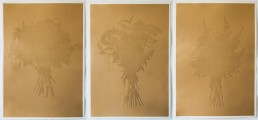
Flower Ornament

An expression of the work of visual Jorge Santos and his privileged experience of nature, Flower Ornament debuts at the Fundação Ricardo do Espírito Santo's Museu de Artes Decorativas Portuguesas and is part of the side programme of ARCOlisboa 2017. Come to open it on may 11th at 6.30pm or visit it until june 30th (from 10am 10a5pm, wednesday to monday, at Largo das Portas do Sol 2).
Flower Ornament is an instalation gathering drawings of flower compositions made by using a printmaking technique called "blind or inkless printing", that prints by stamping/pressing a concavous hard surface onto paper. Jorge Santos' creations will be on display at the museum's temporary exhibition room, in a dialogue between the decorative arts (which set the venue's reputation) and contemporary art (where the artist is inscribed).


Entre / Between
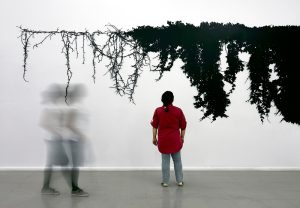
De 05 de Maio a 7 de Junho de 2017, Jorge Santos ocupa uma das quatro salas de exposição do Colégio das Artes, apresentando três obras que se encadeiam numa leitura conjunta.
Trabalhando sobre a percepção e sobre a forma como algo se manifesta, Jorge Santos está atento à relação entre o que o permanece e o que se ausenta, e centrando-se na passagem do tempo e no revelar do outro, as imagens que constrói promovem um grau de ambiguidade e um estado de transição. Entre o que é visivel e o que é sugestionado, o artista debate-se uma condição de passagem, e uma ideia de limite.
No seu trabalho existem sempre dois locais – aquele onde permanecemos, e aquele que mais à frente se anuncia. Como no cinema, a ligação que se estabelece é feita por uma relação entre planos. Uma relação entre a figura que recorta um limite para o espaço onde nos retemos, e o fundo que promete uma expansão para o espaço que se adivinha.
Na gestão dessa fronteira, o limite é por vezes dúbio e a passagem incerta. E quem observa está cativo de um instante, entre o ficar e o seguir, como que simultaneamente escondido e atraído pelo que à frente se anuncia.

Bucólico

Neste mês de Janeiro saiu na revista contemporânea um artigo sobre o trabalho de Jorge Santos, onde apresenta parte da série Bucólico e um vídeo com o mesmo nome feito para esta edição da revista, tudo isto acompanhado por um texto da Joana Consiglieri.
http://contemporanea.pt/Janeiro2017/Jorge-Santos/